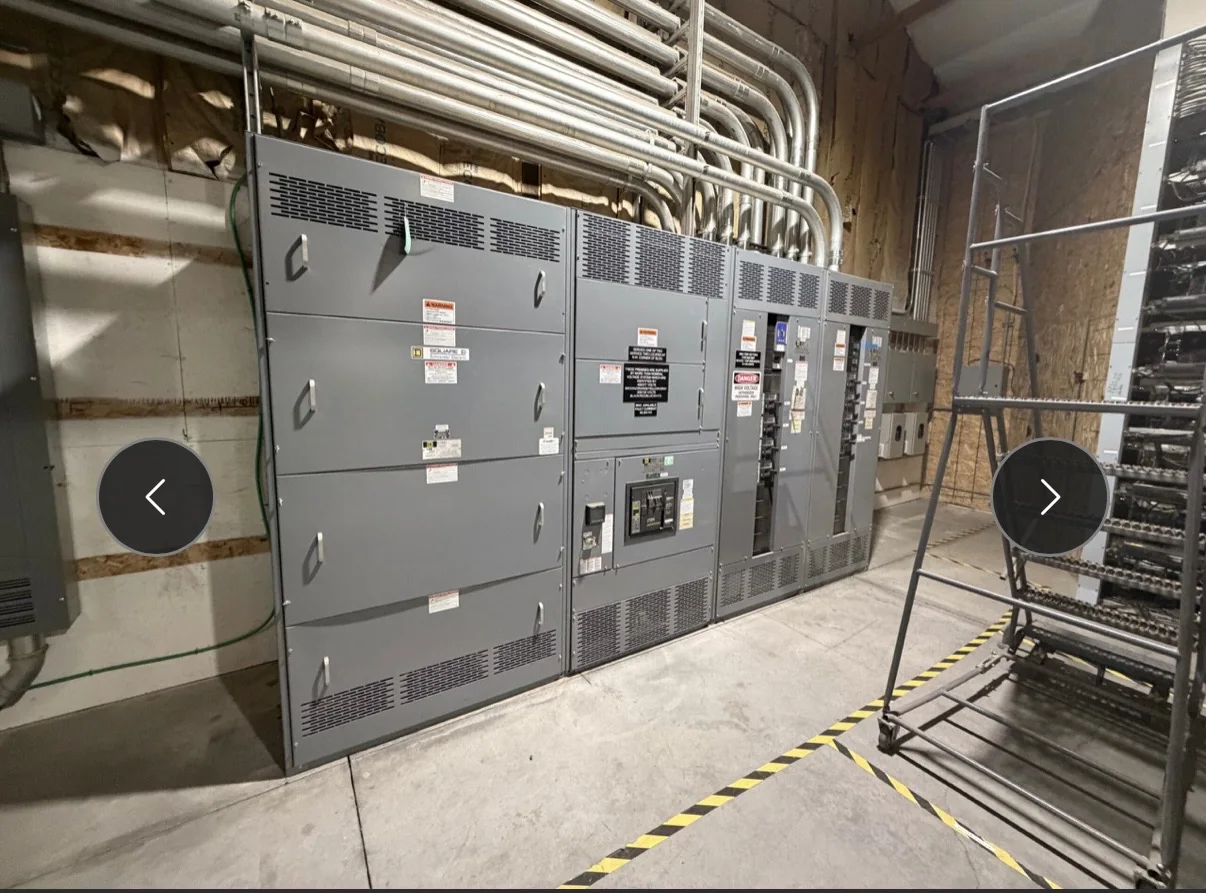
Define the Service Entrance Around the Utility Handoff
A service entrance switchboard sits at a consequential boundary: it receives the building’s incoming supply and distributes power downstream. Start with the serving utility’s service requirements, the project’s calculated demand, and the facility’s planned distribution arrangement—not a catalog frame size. In Freeport, confirm the actual service point and utility coordination path early, especially if the work involves a port-related, petrochemical, manufacturing, or other industrial site with established access and review procedures. The engineer should establish voltage, phase, available fault current, grounding method, metering approach, and service disconnect requirements for the specific project. Those details affect the lineup, protective-device selection, bus design, and physical arrangement. A preliminary one-line diagram gives the manufacturer and project team a common basis for resolving these decisions before a quote is finalized.
Match Ratings and Protection to the Actual System
A proposed switchboard should be checked against the electrical system it will serve, rather than selected from load amperage alone. Request confirmation of continuous-current requirements, interrupting ratings, short-circuit withstand considerations, and the protective-device coordination assumptions shown in the project documents. Available fault current can change with utility conditions or transformer selection; an outdated value can make an otherwise plausible selection unsuitable. Clarify whether the scope includes service-entrance equipment, distribution sections, metering provisions, or specified breakers, and identify any required manufacturer or device compatibility. For facilities with motors, process loads, or planned expansion, document the demand assumptions and foreseeable additions so the design review has a defensible basis. Final ratings and applicability remain project-specific and should be coordinated by the responsible electrical engineer with the utility and equipment manufacturer.


Account for Freeport’s Coastal and Industrial Setting
Freeport’s Gulf Coast location makes it prudent to examine the installed environment and handling route, not simply the electrical schedule. Ask the project team to document whether the equipment will sit indoors or outdoors, whether the room is conditioned, and whether salt-laden air, humidity, washdown, dust, or process contaminants are present. Those conditions can influence enclosure selection, finish, ventilation, corrosion protection, and maintenance access; no particular enclosure or treatment should be assumed suitable without reviewing the site. Confirm door clearances, working space, floor loading, housekeeping-pad dimensions, conduit entry locations, and the route from the unloading point to the electrical room. Industrial campuses may also impose escort, delivery-window, or contractor check-in rules. Recording these constraints before release helps avoid a lineup that meets electrical intent but cannot be moved into position or maintained safely.
Coordinate Replacement Work and an Outage Plan
Replacing a service entrance switchboard is not just a cabinet swap: the existing service, feeder arrangement, terminations, and shutdown sequence all constrain the transition. Before ordering, compare existing drawings with field-verified dimensions, conductor quantities and sizes, entry directions, bus connections, and downstream equipment interfaces. Record which loads cannot tolerate interruption and who has authority to approve the outage. The electrical contractor and facility team should develop the work plan, including required utility coordination and the procedures for establishing an electrically safe work condition; energized installation work must not be treated as an ordinary shortcut. If a temporary source or staged cutover is being considered, make it an engineered, approved part of the project plan rather than an assumed feature of the new equipment. Resolving interfaces early reduces the risk of extended downtime and costly field modifications.
Build a Complete Submittal and Quote Package
A useful request for quote gives the manufacturer enough verified information to price the intended equipment without disguising unresolved engineering decisions. Include the current one-line diagram, load information, utility service data, fault-current information, applicable project specifications, room and access drawings, and a clear scope of supply. Note requested options such as metering, surge protection, spare provisions, or specific protective devices only when they are part of the design basis. Identify governing project standards and required submittal documents, while leaving final applicability and approval to the project engineer and authority having jurisdiction. Ask the manufacturer to identify assumptions, exclusions, and items needing confirmation in its proposal. For a low-voltage switchboard, UL 891 may be relevant when the assembly is appropriately evaluated to that standard; it is not a blanket certification for every product or voltage class.
Review Schedule, Shipping, and Delivery Readiness
Discuss timing against the project’s real milestones: approved submittals, utility reviews, construction access, planned outage, and the date the installation area will be ready. Custom configurations and component choices can affect manufacturing and shipment timing, so request a project-specific schedule and clarify what approvals or design changes could alter it. A U.S. manufacturer can discuss new equipment, American components, custom builds, short lead times, and nationwide shipping, but these offerings do not guarantee a particular configuration or delivery date. For Freeport delivery, confirm the receiving address, carrier access, unloading responsibility, equipment dimensions, site contact, and any port, industrial-facility, or contractor check-in requirements. Protect the equipment in transit and store it as directed until installation. Before shipment, reconcile approved drawings, nameplate details, shipping splits, and receiving arrangements so the delivered lineup matches the reviewed project basis.