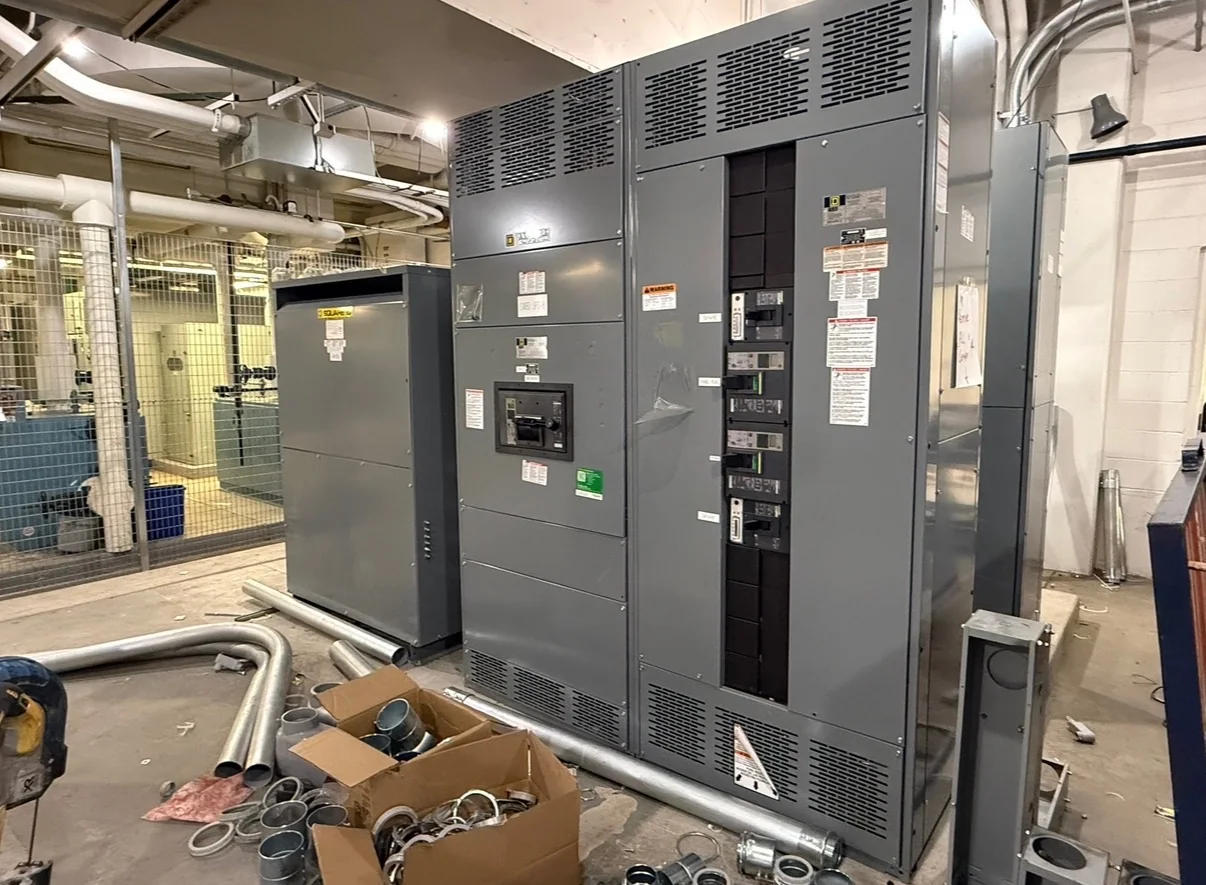
Define the Medium-Voltage Duty Before Requesting a Quote
For a Houston facility, start a switchgear request with the electrical duty, not a preferred lineup size. Identify the system voltage, frequency, available fault current, main and feeder functions, source arrangement, and whether the installation is indoor or outdoor. Include load information and plans for future expansion; these details affect bus arrangement, protective devices, compartment layout, and space allowances. If the gear will connect to a transformer, generator, utility source, or existing switchgear, provide the relevant interface data rather than assuming equipment will match. A U.S. manufacturer can build new equipment around project requirements, but design, ratings, standards, and availability must be confirmed for the specific application. Clear inputs reduce late revisions and help engineers assess suitability before procurement.
Coordinate Protection and System Interfaces
Protection decisions need to account for the entire distribution system, not just the new lineup. Share available short-circuit and coordination studies, one-line diagrams, relay requirements, instrument-transformer information, and the intended connection to upstream and downstream equipment. Confirm how utility or plant protection, grounding, metering, transfer schemes, and communications are expected to interact. Where existing gear remains in service, verify its manufacturer, model, ratings, condition, and connection details; a similar voltage designation alone does not establish compatibility. For Houston industrial facilities with multiple sources or critical process loads, misaligned protection can increase outage scope or prevent selective fault isolation. Have the responsible electrical engineer review settings and interfaces. The manufacturer can use approved project documentation to develop a build, but protection performance depends on the complete, reviewed system.


Plan the Site Around Heat, Humidity, and Flood Exposure
Houston’s hot, humid climate makes enclosure location and environmental controls important design inputs. Document whether equipment will sit in conditioned electrical space, an unconditioned building, or outdoors, and identify expected temperature, moisture, dust, corrosive exposure, and ventilation conditions. Coastal influence, process chemicals, and washdown practices can also change material and enclosure requirements; assess the actual site rather than relying on a citywide assumption. Check elevation and drainage, especially where heavy rain or storm surge planning affects electrical rooms. Switchgear should not be assumed floodproof, corrosion-resistant, or suitable for a given ambient condition without project-specific evaluation. Confirm clearances, access routes, door swing, working space, and maintenance approach on the room drawings. These checks help avoid an installation that fits on paper but cannot be safely accessed or maintained.
Build Procurement Documents That Support a Complete Review
A useful request-for-quotation package gives bidders a consistent basis for technical and commercial review. Include the one-line diagram, equipment schedule, specifications, site conditions, required standards, control and relay requirements, cable-entry preferences, and any defined utility criteria. Mark requirements as mandatory, preferred, or open for manufacturer input so unresolved choices are visible. Ask for a scope description, exceptions, drawing submittals, operating and maintenance documentation, and a list of information needed to release the design. UL 891 applies to appropriately evaluated low-voltage switchboard assemblies; it is not a blanket certification for medium-voltage switchgear. State the applicable evaluation or listing expectations for the actual equipment and project, then verify them during review. Complete documents let procurement compare equivalent scopes instead of treating unlike proposals as interchangeable.
Tie Schedule Discussions to Approval and Release Milestones
When timing matters, ask for a project-specific schedule and identify the decisions that control it. Custom builds and American components may suit defined project needs, but no standard lead time should be assumed without confirming the current scope, component availability, and production capacity. Establish when approved drawings, protection information, interface data, and customer comments are due, and clarify what constitutes authorization to proceed. Review the submittal cycle alongside construction, shutdown, and energization planning; delayed approvals can compress installation preparation even if the equipment schedule itself is unchanged. Request notice of material schedule risks and a clear process for evaluating design changes after release. Avoid basing a cutover date on a preliminary estimate. A documented milestone plan gives the owner, engineer, contractor, and manufacturer a common way to manage dependencies.
Coordinate Houston Delivery With the Installation Plan
Nationwide shipping can support Houston-area projects, but delivery planning still depends on the route, shipment dimensions and weight, unloading resources, and site access. Confirm the receiving address, gate and turning constraints, delivery-hour rules, crane or forklift availability, and whether the electrical room is ready before equipment arrives. Coordinate the shipment sequence with the installing contractor so sections can be moved and set without blocking operations or exposing equipment to weather. For congested industrial sites, refineries, ports, and active plants may impose site-specific check-in, escort, safety, or delivery-window procedures; verify these with the facility rather than assuming standard access. Agree on inspection and documentation at receipt, including how visible shipping damage will be reported. Safe installation and commissioning require qualified personnel, approved procedures, and de-energized work whenever applicable.