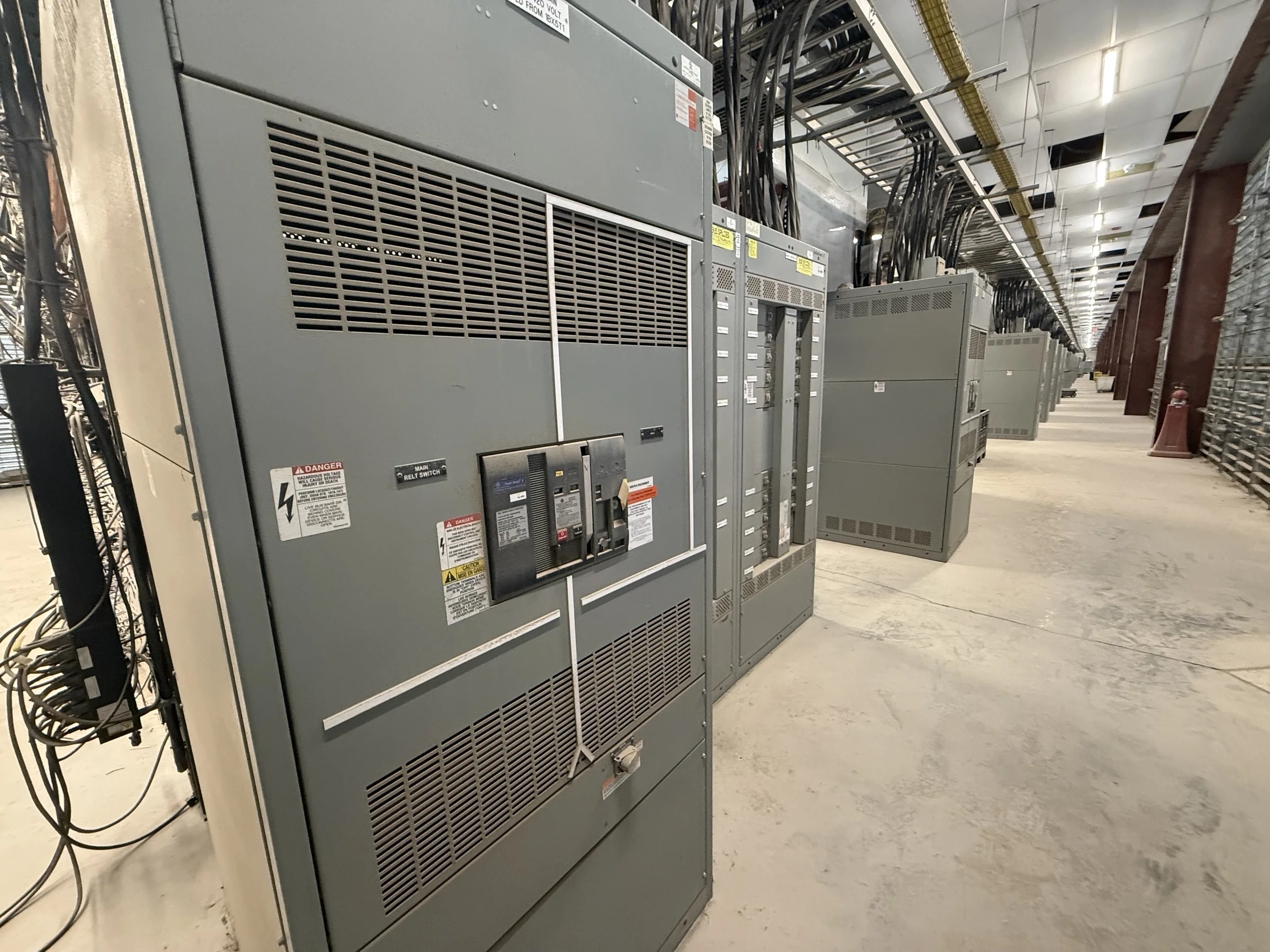
Define the Service Entrance Around the Utility Connection
A service-entrance switchboard is the point where incoming utility power is received, metered, and distributed to a facility, so its design begins with the actual service arrangement—not a catalog label. For a Texas City project, confirm the serving utility’s requirements, available fault current, service voltage, phase, conductor entry, metering provisions, and the location of the service point before equipment is specified. Those details affect bus design, protective-device selection, compartment layout, and whether the proposed arrangement can be coordinated with utility equipment. Provide the latest one-line diagram and utility service documents when requesting a quote; preliminary assumptions can lead to revisions after drawings are reviewed. Final ratings, configuration, code requirements, and utility acceptance are project-specific and should be verified by the responsible engineer and utility.
Match the Board to the Facility’s Load and Distribution Plan
Size the switchboard for the loads it must serve and the way the facility expects to grow, rather than relying on a single estimated demand figure. Gather load schedules, motor and process loads, standby or alternate sources, feeder destinations, and any planned additions. In Texas City’s industrial setting, a site may have process equipment, buildings, and outdoor loads with different operating priorities; the distribution plan should make those relationships clear without assuming a particular facility layout. Engineers can then assess bus capacity, main and feeder devices, spare provisions, and available space for future circuits. Spare capacity is not simply an empty breaker position: it depends on the complete assembly design and the intended electrical conditions. Confirming these requirements early helps avoid costly changes to the lineup, room, or downstream distribution.


Coordinate Protection, Metering, and System Studies
Protective-device choices should follow the facility’s documented electrical system and study requirements. Share available fault-current information, protective-device settings or coordination criteria, arc-flash study inputs, and the latest one-line diagram so the proposed switchboard can be reviewed against the broader distribution system. A device that fits the bus physically may still be unsuitable for the system’s fault duty or coordination goals. Confirm how utility metering, customer metering, control wiring, and any required compartments are to be arranged, since these choices influence enclosure layout and field access. Do not assume a particular interrupting rating, short-circuit rating, labeling, or certification from the product category alone; these details depend on the specified assembly and its evaluation. Qualified professionals should verify final selections and study conclusions before release for manufacture.
Plan the Enclosure and Installation for the Texas City Site
Room dimensions and site conditions can constrain a service-entrance lineup as much as its electrical design. Before approving drawings, check the installation location, clear working space, door and equipment access, ceiling height, housekeeping pad, conduit approach, and the route from the delivery point to the electrical room. Texas City’s industrial sites may also require the project team to consider exposure to moisture, corrosive contaminants, heat, or wind-driven rain, depending on the actual location and enclosure placement. Those conditions should be described during specification review so the enclosure and installation details can be evaluated appropriately; they should not be inferred from the city name. Confirm whether the switchboard will be indoors or outdoors and identify any site-specific environmental requirements. Resolving these constraints early reduces the risk of field modifications or an installation that cannot be accessed safely.
Review Drawings, Standards, and Commercial Scope Before Release
A complete procurement package lets the manufacturer and project team resolve differences before fabrication begins. Include the one-line diagram, specifications, equipment schedules, site and room drawings, utility requirements, and applicable study or coordination criteria. Review submittal drawings for lineup dimensions, incoming and outgoing cable access, device arrangement, metering, labels, and connection details; compare them with the contract documents and installation plan. The U.S. manufacturer offers new equipment, American components, custom builds, and UL 891 assemblies where applicable. UL 891 relates to appropriately evaluated low-voltage switchboard assemblies; it is not a blanket certification for medium- or high-voltage equipment, and a UL listing or label should not be assumed for every configuration. Confirm applicable standards, evaluation, scope, and any requested documentation for the specific project before approval.
Discuss Schedule, Delivery, and Replacement Coordination
Discuss timing with the manufacturer using the project’s actual approval and site-readiness milestones. Drawing review, design revisions, component selection, utility coordination, and delivery access can all affect the schedule, so a short lead-time offering is not a guaranteed delivery date. For a Texas City delivery, confirm the receiving address, site contact, receiving hours, unloading capability, truck access, and any industrial-site check-in or safety requirements before shipment is arranged. Replacement work adds another coordination layer: identify the existing equipment and connections, planned outage window, temporary-power needs, demolition limits, and the sequence for inspection and commissioning. The switchboard must be installed and connected under an approved plan, with equipment de-energized for work as required; never treat energized work as an optional shortcut. Confirm final scope, compatibility, availability, and delivery timing in project-specific documentation.