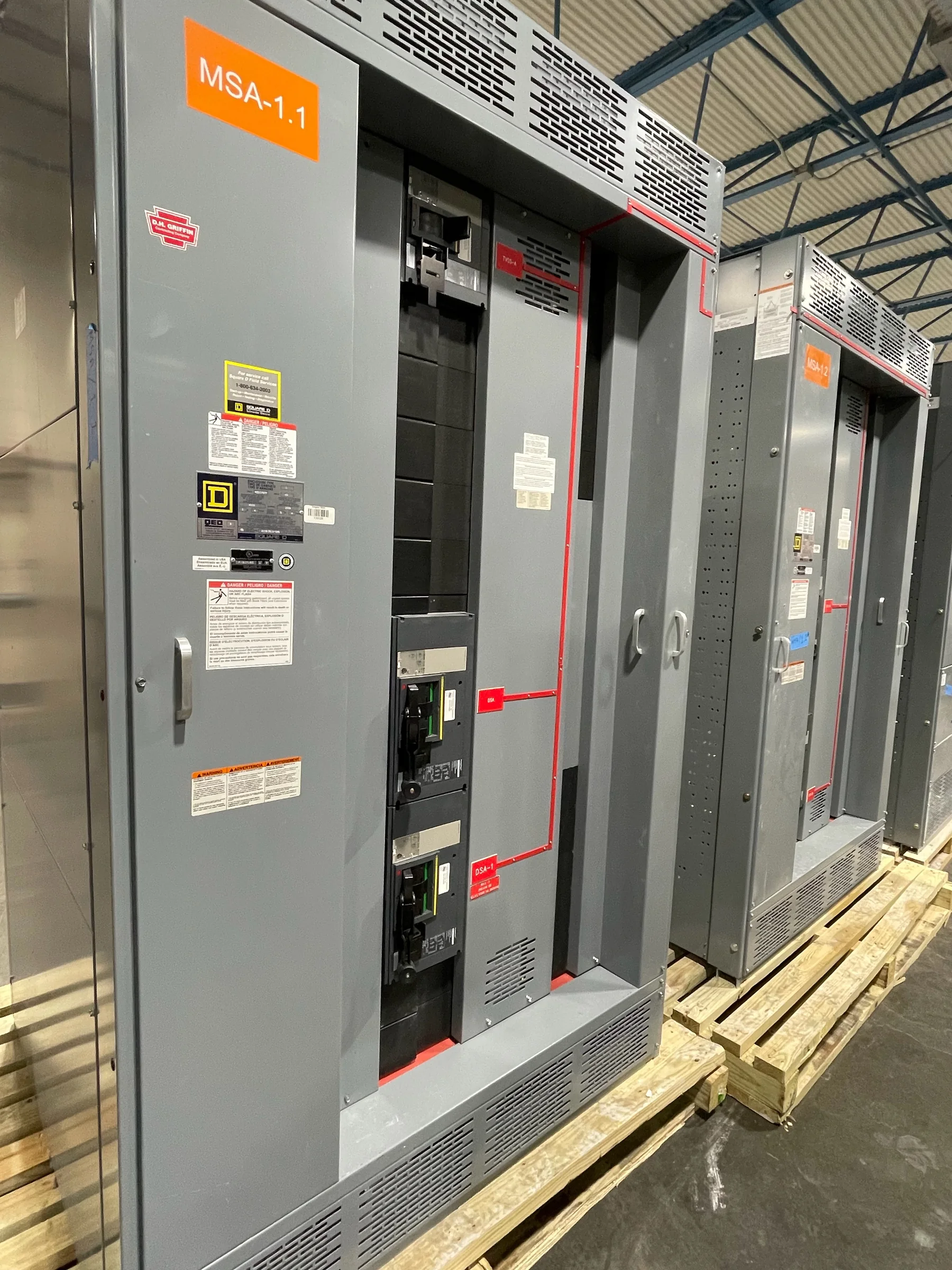
Define the Replacement Scope Before Selecting Equipment
A switchgear replacement in League City should begin with a verified picture of the existing distribution system, not a catalog comparison. Record system voltage, phase, frequency, available fault-current information, service and feeder ratings, grounding arrangement, and the function of each section. Identify whether the equipment is a low-voltage switchboard, switchgear lineup, or another assembly; those terms are not interchangeable, and the distinction affects design and applicable standards. Gather one-line diagrams, equipment nameplates, protective-device data, and prior modification records, then have qualified engineering personnel confirm field conditions. Inaccurate legacy drawings or undocumented changes can create mismatches in bus connections, protection, or enclosure layout. A clearly bounded scope gives the manufacturer a sound basis for a project-specific proposal and exposes information gaps early.
Match the New Lineup to Loads and Protection Needs
The replacement must serve the actual load profile and protection scheme, including changes since the original installation. Compile connected and demand loads, motor starting characteristics, critical circuits, planned expansion, and any alternate-source or generator arrangements. Coordinate breaker frame and trip requirements, interrupting ratings, selective coordination objectives, and upstream and downstream protective devices with the responsible engineer; a rating cannot be assumed from an old label alone. In League City facilities, process loads, HVAC demands, and essential services may have different continuity requirements, so identify which loads can be interrupted and which need a planned transfer or temporary arrangement. The design should also account for available fault current and grounding. These decisions influence assembly configuration, device selection, and review time, while reducing the risk of a replacement that fits physically but fails operationally.


Check the Electrical Room and Connection Interfaces
A lineup that meets electrical requirements can still be unsuitable if it cannot enter the room or connect to existing infrastructure. Measure access doors, corridors, turning clearances, overhead obstructions, floor elevations, and the available working space; verify the route from unloading point to final position. Compare existing conduit, cable, busway, and bus-duct locations with the proposed connection points, and document cable entry direction, conductor size and count, bend constraints, and termination access. Confirm housekeeping-pad dimensions, anchorage conditions, ventilation, ambient conditions, and exposure to moisture or corrosive contaminants where relevant. Gulf Coast weather makes protected staging and a coordinated unloading window practical considerations in League City, but site-specific exposure must be assessed rather than presumed. Early dimensional checks can prevent field rework, delayed installation, and costly changes to room or feeder interfaces.
Plan Shutdowns, Temporary Service, and Installation Boundaries
Replacement timing depends on outage access as much as equipment fabrication. Map the circuits served by the existing lineup, identify allowable outage windows, and determine whether loads can be transferred to another source or need an engineered temporary-power plan. Temporary arrangements require their own capacity, protection, connection, and approval review; they should not be treated as an informal workaround. Agree on responsibility boundaries for demolition, feeder reconnection, controls, testing, and commissioning before procurement, and schedule qualified electrical contractors and facility staff accordingly. All work on existing equipment must follow applicable safety procedures, including establishing an electrically safe work condition before work begins; energized work is not a scheduling substitute. For League City sites with active operations or limited receiving access, coordinate outage approvals, delivery, staging, and installation sequence as one plan so equipment arrival does not outpace site readiness.
Build a Complete Submittal and Quote Package
A useful request for quotation gives the manufacturer enough verified information to evaluate the assembly without disguising unknowns as fixed requirements. Include the one-line diagram, existing equipment photos and nameplates, system and service data, load schedule, fault-current and coordination information when available, connection drawings, room measurements, and requested scope boundaries. State applicable project specifications and the intended application, plus required submittal format, review milestones, documentation, and any owner or engineer approval process. Flag uncertain conditions and ask what additional field verification is needed. The manufacturer can develop a custom build around the project, but exact design, compatibility, standards, labeling, and availability remain subject to engineering review and the final scope. UL 891 applies to appropriately evaluated low-voltage switchboard assemblies; it is not a blanket certification for medium- or high-voltage equipment. Clarifying this distinction avoids unsupported procurement assumptions.
Coordinate Manufacturing, Delivery, and Acceptance
Discuss schedule drivers with the U.S. manufacturer while the design is being finalized: drawing review and approval, component selection, requested options, and resolution of interface questions can all affect the project timeline. Ask for a current, project-specific schedule rather than relying on a general short-lead-time statement, and identify which decisions or approvals could change it. Confirm shipping destination, receiving hours, unloading equipment, truck access, staging limitations, weather protection, and who will inspect and sign for the shipment. Nationwide shipping is an available offering, but delivery arrangements and timing depend on the order and site conditions. Before release, align the approved drawings with field measurements and connection responsibilities. At acceptance, compare delivered sections and documentation with the approved submittal, and coordinate inspection and commissioning with qualified personnel under the project’s applicable requirements.